
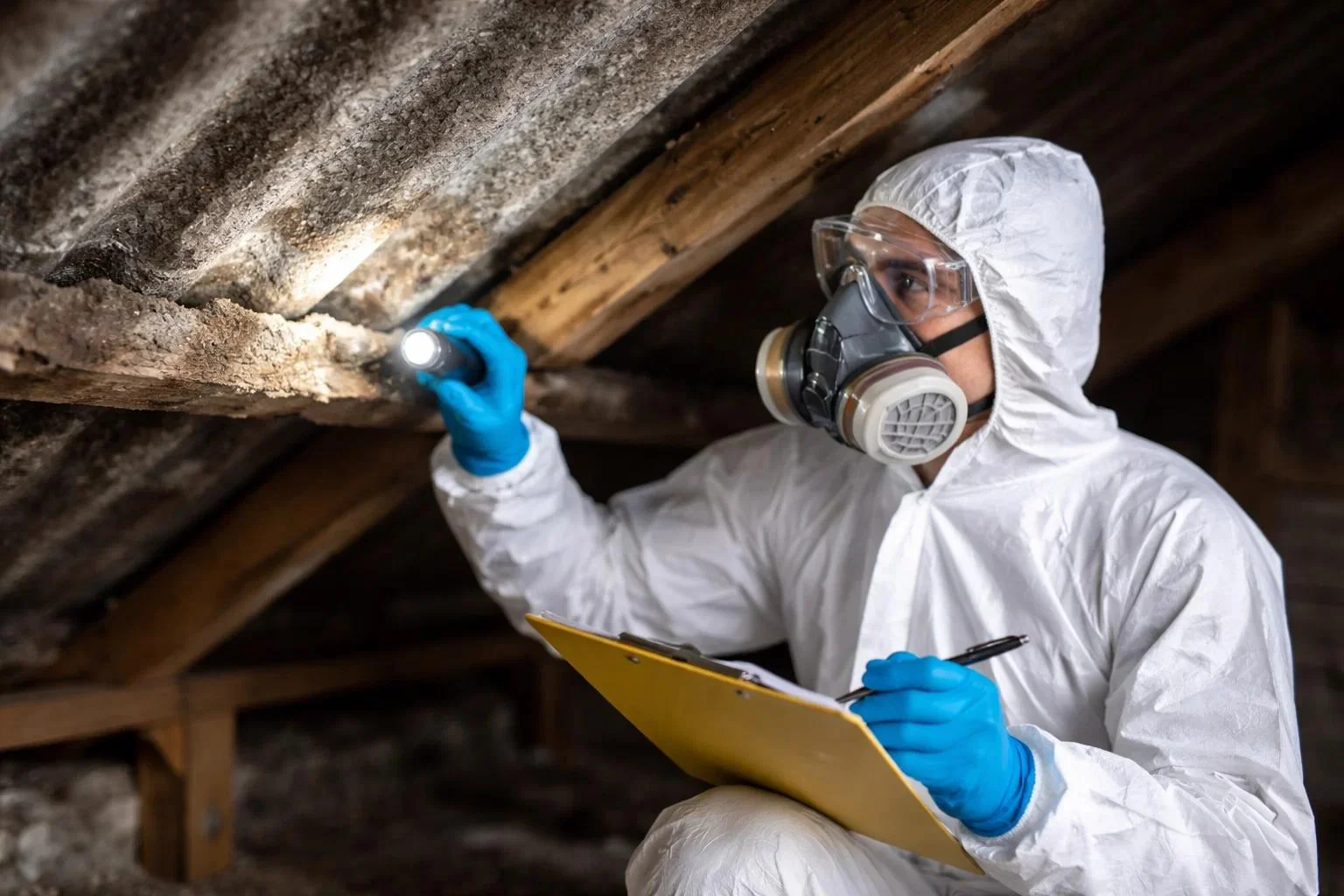
New Technology in Asbestos Testing: What Alberta Property Owners Should Know
Asbestos testing has come a long way, but the basic goal has not changed: determine whether asbestos is present before a material is disturbed and potentially releases fibres into the air.
For homeowners, contractors, property managers, and employers across Alberta, accurate asbestos testing can be the difference between a straightforward renovation and an unexpected asbestos problem. Older drywall compounds, floor tiles, insulation, textured ceilings, pipe insulation, and many other building materials can potentially contain asbestos.
At Ask Environmental, we believe good asbestos management begins with good information. While laboratory analysis remains the foundation of reliable asbestos identification, new technologies are making the testing process faster, more detailed, and increasingly sophisticated.
Better Microscopy, Digital Analysis, and Smarter Sampling
Traditional asbestos testing generally begins with representative samples collected from suspect building materials. Those samples are sent to a laboratory for microscopic analysis. Canada’s federal asbestos management standard specifies Polarized Light Microscopy where possible for bulk samples and notes that Transmission Electron Microscopy is required in some circumstances.
These methods remain important because asbestos fibres are far too small to identify reliably by looking at a building material alone.
Advancements in microscopy have improved our ability to examine challenging samples. Transmission Electron Microscopy offers much greater resolution than conventional light microscopy and can be useful when extremely small fibres or difficult materials need to be investigated. It can also provide more detailed information for certain types of air-sample analysis.
Digital imaging is adding another layer. High-resolution microscope images can be stored, reviewed, compared, and analyzed using increasingly sophisticated software. Rather than relying entirely on an analyst manually examining every field of view, digital systems can assist with recognizing and counting fibre-like structures.
Artificial intelligence is becoming particularly interesting in this area.
Recent research has demonstrated AI systems capable of analyzing phase-contrast microscope images and automatically detecting airborne fibres. A 2025 study using atmospheric samples found that an AI-based system could perform fibre detection dramatically faster than manual counting, although the technology is still developing and does not eliminate the need for qualified analysis.
Other emerging approaches include fluorescence microscopy, where specialized fluorescent probes can help make asbestos fibres easier to distinguish. Researchers are exploring portable fluorescence systems that could eventually provide faster on-site screening. These technologies remain an evolving area, and fluorescence alone cannot yet definitively identify asbestos.
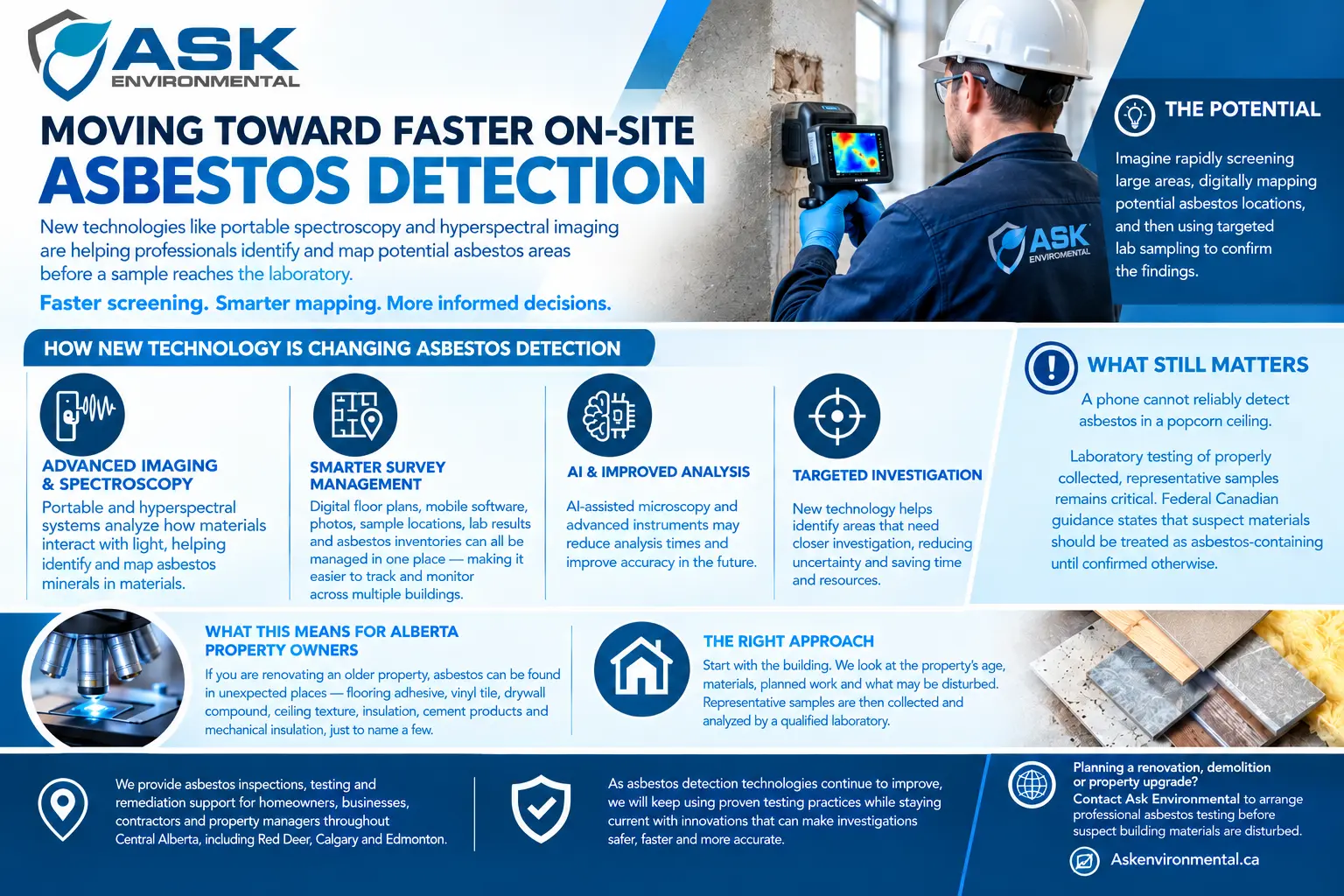
Moving Toward Faster On-Site Asbestos Detection
One of the most promising areas of development is the possibility of obtaining useful information before a sample ever reaches the laboratory.
Researchers are exploring portable spectroscopy and hyperspectral imaging systems that analyze how materials interact with different wavelengths of light. A 2025 study demonstrated a portable near-infrared hyperspectral imaging approach capable of identifying and mapping asbestos minerals in tested materials.
The potential is significant. Imagine assessing an older commercial building and being able to rapidly screen large numbers of suspect materials, digitally map potential asbestos locations, and then use targeted laboratory sampling to confirm the findings.
Technology is also changing how asbestos surveys are managed. Digital floor plans, mobile inspection software, photographs, sample locations, laboratory results, and asbestos inventories can increasingly be brought together into one record. For owners managing multiple buildings, that can make it easier to know where asbestos-containing materials are located and what condition they are in.
None of this means we are at the point where someone can point a phone at a popcorn ceiling and receive a trustworthy confirmation of asbestos. We are not there yet.
Laboratory testing of properly collected representative samples remains critical. Federal Canadian guidance states that suspect materials should have their asbestos status confirmed through laboratory analysis and treated as asbestos-containing until confirmed otherwise.
Where technology is making a real difference is in supporting that process. Better instruments, improved imaging, smarter software, and more efficient data management can help professionals make better-informed decisions while reducing some of the uncertainty surrounding asbestos investigations.
What New Testing Technology Means for Alberta Property Owners
For most homeowners, the technology behind the microscope is not the most important consideration. What matters is receiving an accurate answer before starting work.
If you are renovating an older Alberta property, asbestos can sometimes be found in places you would not expect. Flooring adhesive, vinyl tile, drywall joint compound, ceiling texture, insulation, cement products, and mechanical insulation are just some examples of materials that may require investigation.
That is why we still start with the building rather than the technology.
We look at the age of the property, the materials present, the planned renovation or demolition work, and which materials are likely to be disturbed. Representative samples can then be collected and submitted for appropriate analysis.
New asbestos detection technology has tremendous potential, particularly as AI and advanced imaging continue to improve. Research published in recent years shows how quickly the field is moving. AI-assisted microscopy may eventually reduce analysis times, while portable screening technologies could help professionals identify areas requiring closer investigation.
But faster should never mean careless.
A sophisticated instrument cannot compensate for an unrepresentative sample or a poorly planned asbestos survey. The best results still come from combining knowledgeable inspection and sampling with appropriate laboratory analysis and experienced interpretation.
At Ask Environmental, we provide asbestos inspections, testing, and remediation support for homeowners, businesses, contractors, and property managers throughout Central Alberta, including Red Deer, Calgary, and Edmonton.
As asbestos detection technologies continue to improve, we will keep using proven testing practices while staying current with innovations that can make investigations safer, faster, and more accurate.
Planning a renovation, demolition, or property upgrade? Contact Ask Environmental to arrange professional asbestos testing before suspect building materials are disturbed.
Frequently Asked Questions About New Asbestos Testing Technology
1. Can asbestos be detected instantly on-site?
Emerging portable technologies are making rapid screening more realistic, but professional laboratory analysis remains important for confirming asbestos in suspect building materials. On-site screening should not be treated as a replacement for appropriate sampling and laboratory testing.
2. Can AI detect asbestos?
Researchers are successfully using artificial intelligence to help identify and count fibre-like structures in microscope images. AI-assisted analysis is promising, particularly for speeding up repetitive microscopic work, but qualified professionals and established analytical methods remain essential.
3. What is the most common method for testing building materials for asbestos?
Polarized Light Microscopy is widely used for analyzing bulk building-material samples. Other methods, including Transmission Electron Microscopy, may be used when more detailed analysis is required or for particular materials and applications.
4. Can I use an asbestos testing kit instead of hiring a professional?
The laboratory analysis may be accurate, but collecting a representative sample without unnecessarily disturbing suspect material is an important part of the process. Professional assessment and sampling are recommended, particularly when multiple materials or a larger renovation are involved.
5. Will new technology make asbestos testing faster in the future?
Very likely. AI-assisted microscopy, automated fibre counting, fluorescence techniques, and portable spectroscopy are all being actively researched. The direction is toward faster screening and analysis while maintaining the accuracy needed to make sound asbestos-management decisions.